Usage, cost and monitoring
For: product owners, customers and platform owners.
What is charged
Only a provider call has a cost. Everything else is free and uses no quota.
| Source | Cost | Uses quota |
|---|---|---|
| Geofence, Plus Code, coordinates | None | No |
| Internal addresses | None | No |
| Cache | None | No |
| Provider | One call | Yes |
| Place by hand, reject | None | No |
A call is charged when the provider responds, even if the place needs review.
Two different prices
| Price | Who pays whom | Where it is set |
|---|---|---|
| Cost per call | The platform pays the provider | Platform geocoding connection |
| Plan: monthly price, included calls, price per call over the quota | The organization pays the platform | Settings › Platform › Geocoding › Plan |
An organization’s charge in a month:
charge = monthly price + (calls over the quota × overage price)Overage is charged only if the subscription says Charge overage. With Send to review and Apply the quotas on, when the quota runs out the platform stops calling and new places go to review.
With Apply the quotas off, no call is refused. An organization on Send to review keeps calling over its quota: those calls are not charged to it, but the provider charges them to the platform.
Cost per trip
A place is located once. Later trips to the same place use its geofence. The cost depends on how many new places appear, not on how many trips there are.
Example with assumed values:
| Assumption | Value |
|---|---|
| Trips per month | 3,000 |
| New places in the first month | 200 |
| Of those, resolved by geofence, Plus Code, internal addresses or cache | 120 |
| New places in later months | 20, of which 8 go to the provider |
| Cost per call | US$0.005 |
| Month | Provider calls | Provider cost | Provider cost per trip (paid by the platform) |
|---|---|---|---|
| First | 80 | US$0.40 | US$0.00013 |
| Later | 8 | US$0.04 | US$0.000013 |
What lowers the cost most: geofences already drawn for frequent places, Plus Code in the spreadsheet and addresses written as in the internal sources.
Where to see it
| Who | Where | What they see |
|---|---|---|
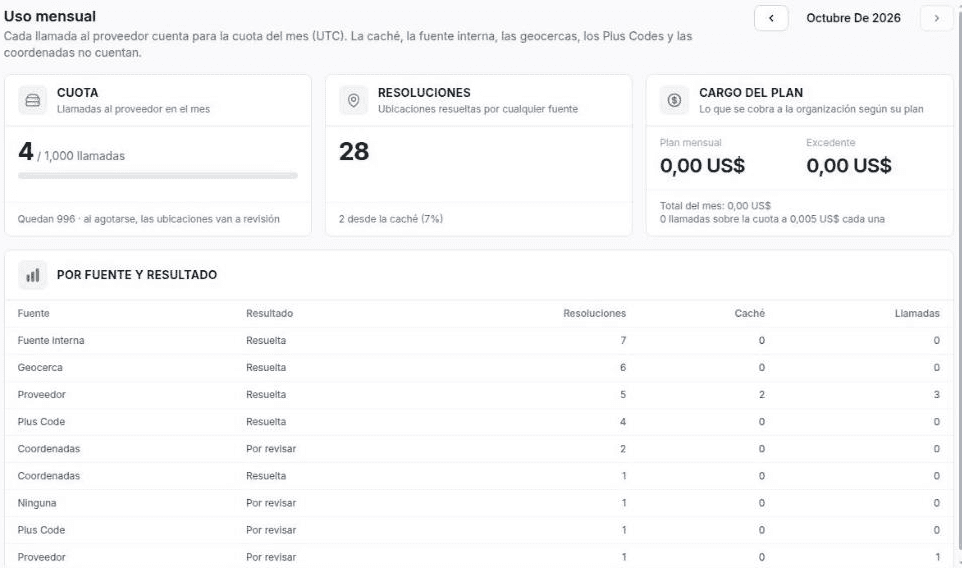
| Organization owner | Settings › Trips › Monthly usage | Calls against the quota, resolutions by source and result, cache hits, plan charge |
| Platform owner | Settings › Platform › Geocoding › Organizations | Per organization: used / quota, cache, provider cost, charge, mode when used up |
| Operations | Settings › Trips › To review | Places without a reliable point and the reason |
| Technical team | geocoding.* metrics | Resolutions, cache, provider latency and errors, quota refusals |
Alerts
When an organization with a subscription and a quota greater than zero reaches the plan’s alert percentage (80 % by default), the platform publishes the geocoding.quota.threshold event, once per month.
Pitfall: the event does not send messages on its own. For someone to receive the alert, create a rule on that event in the organization. The platform owner receives no alert; check the Organizations table with the On alert or Used up filter.
Audit
| Record | What it answers |
|---|---|
| Geocoding usage | How many resolutions, from which source, how many to the provider and at what cost, per organization and month |
| Trips audit | Who resolved, placed by hand or rejected each place, and with which source and geofence |
| Feed jobs (Integrations › Job console) | Which places each feed service tried to locate |
| Terms history | Which plan and which quota applied in each month |
Details of tables and metrics in Data and metrics.
Risks by country
| Country | Risk | Mitigation |
|---|---|---|
| Chile | Low for addresses with a number in districts with internal data | Write street and number as in the official register |
| Peru | High: the provider is not certified; many addresses go to review or fall in another district | Plus Code or coordinates in the spreadsheet; drawn geofences |
| Others | Everything goes to review: no administrative boundaries are loaded | Certify the country before offering it |